About
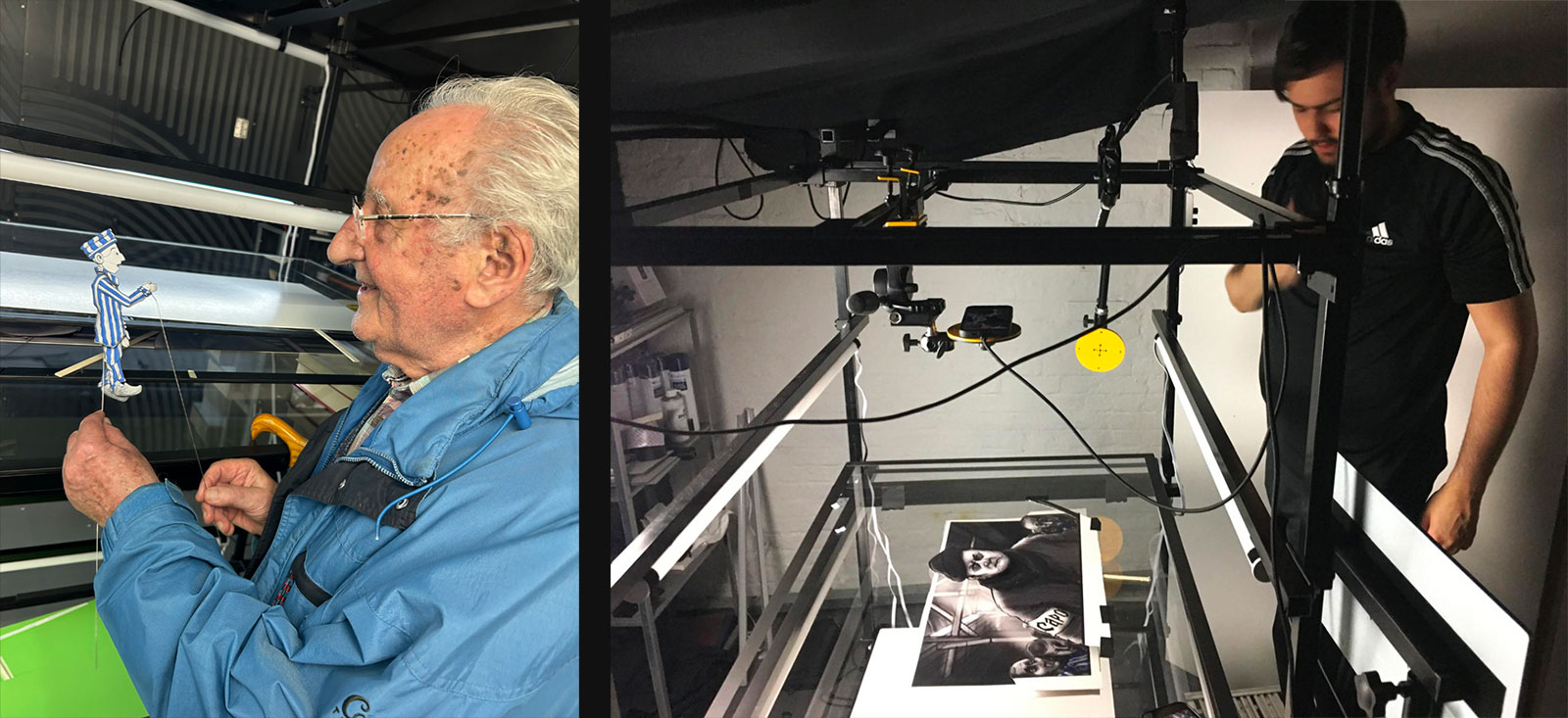
Zoom Rockman has taken the testimony of Ivor Perl BEM and created a groundbreaking animated drama depicting the Holocaust as it has never been seen before. In a world of ever evolving AI and Virtual Reality, his low tech end product stands out as a timeless and future-proof historic document.
Every puppet, uniform, weapon and vehicle was sketched out, beautifully hand crafted and puppeteered using wire, sticks and split pins. A filming platform was constructed of multiple glass layers, cobbled together in his studio and fitted with an old mangel to feed through the background scenery. The entire project took exactly a year to complete and was filmed in 4K on an iPhone over 96 days.
Every character was based on historical photo references of real people. Zoom’s own unique paper puppetry techniques breathed life into lost souls of the Holocaust who are eventually revealed in the end credits with a heart-wrenching gut punch of emotion.
Of a generation increasingly exposed to Holocaust Denial and fake news, Zoom set out to make an authentic film for a predominantly non-Jewish audience.
Ivor Perl arrived at the gates of Auschwitz at age 12, and it was Zoom’s intention for SURVIVOR to be viewed by children of the same age. It succeeded in getting a 12A rating.
Authenticity was key to this project with every location verified, visited and cross referencd on maps so that all scenes would be spatially accurate. Every word is spoken in its original language. Zoom thoroughly researched the gas chamber mechanics to make sure these scenes were depicted accurately. He referenced multiple artworks by the Artist, David Olere, who worked in the Sonderkommando disposing of the bodies. These became the basis for compositions in the film in which Olere himself is depicted alongside Ivor’s older brother, David. Drawings published in ‘The Sketchbook from Auschwitz’ found hidden under a bunker after the war, were used as reference for many tiny details such as car number plates and spellings.
The decision to use the blue, black and white colour combination was inspired by a 2017 school trip to Majdanek concentration camp. Standing in the gas chamber, Zoom had enquired about staining on the walls and was told that this was caused by a chemical reaction between the Zyklon B gas and material used in the construction of the building. The bright Prussian blue stayed with him, and although at first he only intended for it to appear in the Sonderkommando scenes, he eventually let it seep out into the rest of the film.
Now being described as a game changer in Holocaust Education, with related teaching resources currently being developed and screening installations designed for Holocaust Museums across the world. Hundreds of beautiful puppets, props, pieces of scenery, photographs and books have been archived in Zoom’s studio with a worldwide, travelling exhibition planned for 2027.